



Modern smart alarms are evolving beyond simple sirens and basic alerts. They now include features such as system health checks, remote management, real-time notifications, mobile apps, and multiple communication options, including cellular, Ethernet, and Wi-Fi. While wired systems remain preferred for high-performance, secure, and outdoor setups, wireless systems are becoming more popular due to their easier installation and maintenance.
Today, remote access to alarm systems for configuration, activation, deactivation, and alerting is standard. Additionally, bringing surveillance into the alarm market enables video verification, which helps reduce false alarms, and the use of video for direct intrusion alerts is increasing across various industries.
SMART Security Solutions asked two companies involved with smart alarms for their insights into the market, where it’s heading and what’s happening in the real world. Our questions are answered by:
• Brett Lewin, Paradox product manager, Spectrum Security Products, and
• Gary Swart, marketing executive, ArxTech.
SMART Security: Alarm and intrusion security systems are far smarter today than ever before and making a noise or sending an alert to a guarding company is basic functionality that is expected out of the box. What would you consider ‘standard functionality’ in new smart alarm installations today?
Lewin: Today’s smart intrusion systems are becoming intelligent security platforms that deliver awareness, automation, and real-time interaction.
Standard functionality in new smart alarms now typically includes remote control via smartphone applications, instant push notifications, multiple communication paths such as IP and cellular backup, user-specific access management, and integration with cameras and smart devices. End users increasingly expect the ability to arm and disarm their systems remotely, receive detailed event notifications, bypass zones, review system status, and control automation features from anywhere.
Another major expectation is system reliability and resilience. Modern platforms such as the Paradox M25 are designed with encrypted wireless and reporting communication, high-speed processing, and advanced user management facilities to ensure secure and consistent operation in both residential and commercial environments.
Intelligent intrusion detection is also becoming standard. Rather than simply reacting to an intrusion event, systems are expected to distinguish genuine threats from nuisance activations using smarter detection technologies, cross-zoning, and integrated video verification capabilities, such as the Paradox M25/Provision CCTV hybrid system.
The modern alarm system has evolved into a connected security ecosystem that integrates intrusion detection, awareness, automation, and user convenience into a single platform.
Swart: Modern alarm systems are expected to do far more than simply trigger a siren or send a signal to an armed response company. Standard functionality today should include automated health tests, multiple communication channels, remote management capabilities, and intuitive mobile applications.
Users should have greater control over their systems, including real-time notifications, remote arming and disarming, and the ability to monitor the installation’s overall health. Communication methods, such as cellular and Ethernet, have also become essential to ensure that alarm reporting remains operational even if a single communication channel fails.
SMART Security: Has wireless connectivity become standard for smart alarms, or are systems still being connected via cables? What are the pros and cons of wired vs wireless?
Lewin: The industry today is largely hybrid. While wireless technology has grown significantly in popularity, wired infrastructure still plays a major role in many professional security installations. The most effective systems are those that seamlessly support both technologies, allowing installers to design solutions tailored to the environment and customer requirements.
Wireless devices have become extremely popular because they allow for faster installation, minimal disruption to properties, and easier expansion. They are especially valuable in retrofits, apartments, heritage buildings, and sites where cabling is difficult or expensive. Modern wireless technology, including the encrypted wireless ecosystem supported by the Paradox M25, provides excellent reliability, supervision, and long battery life, as well as the ability to convert existing wired alarm systems to the new M-System.
However, wired systems still offer advantages in certain applications. Hardwired devices typically provide continuous power, reduce maintenance associated with battery replacement, and can be ideal for high-security or large commercial installations where infrastructure already exists.
However, hybrid systems are increasingly becoming the preferred choice because they provide flexibility. Installers can use wired devices where permanent infrastructure is practical, while deploying wireless sensors in difficult or remote areas. This approach allows the system to balance reliability, scalability, installation speed, and cost efficiency.
Ultimately, the debate is no longer ‘wired versus wireless’. The market is moving toward intelligent hybrid security systems that leverage the strengths of both technologies.
Swart: Both wired and wireless technologies continue to play an important role in modern alarm installations, with each offering unique advantages.
Wireless advantages: Wireless devices simplify installation and reduce the need for extensive cabling, making them ideal for existing homes and buildings. Advances in radio technology and smart communication protocols provide excellent range and reliability. Two-way communication allows the control panel to continuously monitor device status and battery condition, enabling users to receive early low-battery warnings. This same two-way communication can also be used to activate gates, garage doors and other devices through the smart alarm system.
Wireless disadvantages: Wireless devices rely on batteries, which typically require replacement every two years. Although systems provide early warning of low battery conditions, periodic maintenance remains necessary.
Wired advantages: Wired devices are ideal for high-performance sensors that require additional power, such as multi-element detectors and active infrared beam systems. They provide long-term reliability and are well suited to high-security and outdoor applications.
Wired disadvantages: Cabling can deteriorate over time, particularly in coastal environments where corrosion is prevalent. Incorrect cable routing or physical damage can also affect system performance, as can surges and lightning.
For many installations, a hybrid approach that combines wired and wireless devices provides the greatest flexibility and reliability.
SMART Security: App functionality varies between manufacturers. What functionality should buyers look for and consider essential? Is integrating alarm and intrusion systems into a broader home automation solution common or still restricted to niche buyers?
Lewin: Mobile applications have become a central part of the user experience in modern security systems, and buyers should evaluate both usability and functionality when selecting a platform.
At a minimum, users should expect reliable remote arming and disarming, instant push notifications, event history, zone status visibility, user management, and real-time system health monitoring. More advanced platforms, such as the Paradox M25 ecosystem, also provide automation control, programmable outputs, scheduling, and integration with Provision CCTV; the company will soon launch its own range of smart home devices.
Cybersecurity is another essential consideration. Buyers should look for encrypted communication, secure authentication, and reliable cloud infrastructure to ensure their systems remain protected against unauthorised access.
The integration of alarm systems into broader smart home and building automation environments is no longer limited to niche buyers. While luxury homes were early adopters, mainstream consumers increasingly expect their security systems to integrate with lighting, gates, garage doors, energy management, and surveillance systems.
Security is becoming the foundation of the connected property. When intrusion systems can communicate with automation devices, the result is not only improved convenience, but also improved situational awareness and faster response during security events.
Commercial environments are following the same trend, with integrated platforms increasingly being used to combine intrusion detection, access control, video surveillance, and automation into unified systems that can be managed centrally.
Swart: The mobile application has become one of the most important components of a smart alarm system. Buyers should look for systems that provide immediate push notifications and real-time status updates. Early warning notifications are essential because they enable users to respond to incidents before they arrive home or return to their business premises.
Remote control capabilities are equally important. Users should be able to arm and disarm the system, manage users, and control external devices such as gates, garage doors, lights and access-controlled doors. Confirmation of these actions should be sent back to the user through the application.
Integration with broader home and building automation solutions is becoming increasingly common and is no longer limited to niche buyers. Consumers increasingly expect security systems to become part of a connected environment that provides convenience, energy management and enhanced safety.
SMART Security: How widespread is video verification becoming when it comes to acknowledging and responding to alarms?
Lewin: Video verification is rapidly becoming one of the most important developments in the smart alarm industry. Traditional alarm activations often rely solely on sensor triggers, which can lead to uncertainty, false alarms, and slower response times. By integrating video verification, monitoring centres and security providers can visually confirm whether a real intrusion or threat is taking place before dispatching resources.
This technology is becoming increasingly widespread across both residential and commercial installations, particularly in environments where rapid decision-making and operational efficiency are critical. End users are also becoming more aware of the value of visual confirmation, especially when receiving remote alarm notifications via mobile applications.
Modern systems now allow alarm events to trigger linked cameras, snapshots, or live video streams that can be viewed immediately by users or monitoring operators. This significantly improves situational awareness and helps reduce unnecessary callouts.
The trend toward hybrid security solutions is accelerating the adoption of video verification. Integrating intrusion detection with intelligent CCTV analytics creates a more proactive security ecosystem that identifies threats earlier and provides stronger evidence during incidents.
The Paradox M25 platform supports this modern approach through integration capabilities that enable smart interactions among intrusion systems, connected devices, and the broader security infrastructure. As security expectations continue to rise, video verification is moving from a premium feature toward becoming a standard expectation in advanced smart alarm deployments.
Swart: Video verification is becoming an increasingly important element of modern intrusion detection systems. By combining alarms with intelligent video analytics, users and monitoring centres can quickly determine whether an event is genuine or a false alarm.
Camera analytics such as tripwire detection, person detection and intrusion zones can be used to trigger alarm events, particularly in outdoor environments where traditional passive detectors may be less effective. Although cameras often operate through separate applications, they provide valuable visual confirmation that enables faster and more informed responses.
As artificial intelligence and video analytics continue to improve, video verification is rapidly becoming a standard expectation rather than a premium feature.
SMART Security: What solutions and services does your company provide to the smart alarm market?
Lewin: Spectrum Security Products provides a comprehensive range of smart intrusion and security solutions built around reliability, scalability, and intelligent connectivity. We focus on delivering professional-grade systems that meet the needs of both residential and commercial environments.
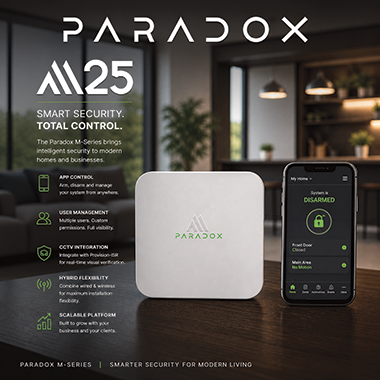
At the core of our offering is the Paradox M25 platform, a modern hybrid intrusion system that supports both wired and wireless devices and enables advanced smart security functionality. The platform provides flexible expansion capabilities, strong communication options, app-based remote management, and integration with broader security and automation ecosystems.
Our solutions include intrusion detection, perimeter protection, wireless detectors, keypads, remote controls, automation modules, hardwire zone expansion modules and cloud-connected mobile management through the Paradox ecosystem. Users benefit from real-time notifications, remote arming and disarming, multi-site management, and immediate access to system status from mobile devices.
We also support integration between alarm systems and complementary technologies such as CCTV with video verification, access control, and home or business automation. This allows installers and end users to build unified smart security environments rather than isolated standalone systems.
In addition to technology solutions, we work closely with installers, distributors, and monitoring companies by providing technical support, product training, system design assistance, and ongoing channel enablement. Our goal is to ensure that security professionals can deliver dependable, future-ready smart alarm solutions that adapt to evolving customer expectations and modern security challenges.
Swart: ArxTech’s SmartArx advanced alarm platform provides a comprehensive, scalable security solution for residential and high-risk commercial environments.
SmartArx has been engineered and manufactured locally, ensuring exceptional reliability in harsh operating environments. The modular architecture allows customers to expand the system as their requirements evolve. It also supports both wired and wireless devices, with two-way communication that provides continuous supervision, battery monitoring, and system health checks.
SmartArx supports multiple communication paths, including Ethernet, Wi-Fi, and dual GSM. Users can prioritise primary and secondary communication channels to ensure uninterrupted alarm reporting. Multiple wired and wireless inputs and outputs enable the system to control lights, gates, garage doors, access control devices and other automation functions directly from the mobile application.
The SmartArx Advantage
• Locally developed and supported.
• Designed for residential, commercial and high-risk environments.
• Modular and scalable architecture.
• Supports both wired and wireless technologies.
• Two-way communication with device health monitoring.
• Dual GSM, Ethernet and Wi-Fi communication options.
• Remote control and management via a user-friendly mobile application.
• Automation of gates, doors, lights and other devices.
• Integration with cameras providing video analytics and third-party systems.
• Reliable operation in demanding African environments.
These capabilities enable SmartArx to provide not only intrusion detection, but also a complete intelligent security ecosystem that gives users greater visibility, control, and peace of mind.
| Tel: | +27 21 561 7800 |
| Email: | [email protected] |
| www: | www.spectrumsp.co.za |
| Articles: | More information and articles about Spectrum Security Products |
| Tel: | +27 11 543 5800 |
| Email: | [email protected] |
| www: | www.technews.co.za |
| Articles: | More information and articles about Technews Publishing |
| Tel: | +27 11 543 5800 |
| Email: | [email protected] |
| www: | www.securitysa.com |
| Articles: | More information and articles about SMART Security Solutions |
| Tel: | +27 12 644 1285/1880 |
| Email: | [email protected] |
| www: | www.arxtech.co.za |
| Articles: | More information and articles about Arxtech |






© Technews Publishing (Pty) Ltd. | All Rights Reserved.
 printer friendly version