


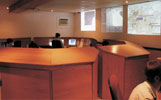
When ROM was established in 1997 it was the front runner of off-site monitoring and has today become the largest control room monitoring company in South Africa.
Remote off-site monitoring is a specialised field of security and not to be taken lightly. ROM's control room is a 24 hour operation that never gets quiet during any hour of the day. A well built team consisting of installers, installation managers, IT specialists, sales department, financial department, and of course the controllers and control room managers, making sure each customer receives full attention on their site through remote off-site monitoring. It is not just having a PC with a camera, the concept of the remote off-site monitoring was fully examined by the directors first.
With ROM's solutions we are able to remotely view cameras as well as manage the cameras, speak to any person on the site through voice over IP, open and close doors, switch lights on and off, open and close gates for access control and trigger any apparatus on site. This is just a few of the basic everyday operations that ROM deals with. Included in these services that are offered are also a range of maintenance contracts to suit any facility. As installers of access control as well as asset control, ROM does not leave the painful headache to the client of a camera that is down or a turnstile with biometric readers not working, ROM fix it.
Another major advantage of remote off-site monitoring is its inherent impartiality and its imperviousness to collusion. While it might be possible to intimidate, confuse or even bribe a security guard to gain access to a business premises, there is simply no way to influence the person monitoring the premises from off-site control room.
With the permission of its IT managers ROM can allow the directors of any business to also remotely view his own camera system. When travelling is required to most owners or simply wanting to see what is happening at night, it can allow extra charges to software or access charges.
Based on its security level agreement, it will submit an activity report to the site representative at intervals agreed upon. This report will comprise of how many motion alarms were received, what caused the alarms and what action was taken by the surveillance controllers, how often did the security officer patrol the site and any other activity that took place? CCTV camera faults will also be reported and managed.
Being in the security business for as long as ROM has, relationships with not only business owners are built each day, but also with suppliers making sure ROM has the right product on the market and software is running to full capacity for smooth success. Due to the high prices of technology, ROM offers a rent-to-own equipment affordable while cost.
Why remote video monitoring
Primary causes of false alarms are poorly designed and installed security systems or human error in operating them. Even simple actions like the positioning of an advertising module or display near a ventilation outlet may result in a false alarm when it moves in the air currents. Therefore, it is not a practical proposition to eliminate all false alarms at the source, though careful design and installation of the motion detectors can dramatically improve the situation.
A viable alternative to physical attendance on site is to provide a means of remote verification from a centralised monitoring location. Attendance is then only necessary when a real threat is judged to exist. For this approach to be truly effective, it must be quick and easy to determine the cause of each and every alarm. Most people understand the theory of the intruder alarm system: this being detectors strategically positioned in a building, door contacts and a control panel that is usually connected to internal and external sirens on site, and connected via a standard telephone line to a remote off-site facility.
Clients are under the illusion that this protects their premises, but in reality it does not make the doors any stronger or the windows any tougher, they still break when struck.

What does it achieve?
An intruder alarm system works predominantly when the premises are unoccupied. An intruder will approach a building and spend some minutes looking through windows, trying doors etc, and, if challenged, will make the lame excuse of "Oh, sorry are you closed?" or simply run.
If left unchallenged the intruder has free access to the building perimeter and any items that are stored outside the premises are susceptible to theft. An ideal opportunity is also presented to the would-be intruder to determine the best access point to the building. An intruder can, by simply looking through a window, see all manner of expensive office equipment including laptops, PCs and digital cameras left on desks. The building occupants assume they are protected by the alarm and the 'it will not happen to them scenario'.
The intruder who has been left unchallenged will eventually smash a window or force a door, which in turn will activate the alarm and send a signal through to the Alarm Response Facility. The experienced intruder, having surveyed the site prior and knowing what he is going to target, once inside will quickly gather the equipment and leave through the same route prior to the arrival of the patrol officer. Nothing has stopped them and the client has sustained a loss and damage to the premises.
The loss can be viewed in a number of ways:
1. Costs incurred due to damage to the premises and the ensuing repair and maintenance works. Additional costs may also arise if alternative premises need to be sourced whilst these repairs are being undertaken. The often unconsidered cost is the uninsurable value of loss of time.
2. Actual loss of capital equipment is covered by an insurance policy, but what if the items are scheduled to be delivered to a client tomorrow and there are penalty clauses for late delivery and again an uninsurable cost eventuates. A worse scenario would be if all your business critical information was stored on the stolen PC, you could severely jeopardise the long-term viability of your company.
In fact, intruder alarm systems are useful, but you should understand what they are designed to do. An intruder alarm system is designed to detect an intruder after they have broken into the premises and at best will limit. In a single sentence, an intruder alarm system is designed to limit loss and not prevent the actuality.
Remote Off-Site Monitoring's main purpose is to detect and deter before the criminal element breaches the alarm activation.
For more information contact Laurence Strydom, Raw Fire Security, +27 (0)11 425 0146, laurence@rawfiresecurity.com or Remote Off-Site Monitoring.






© Technews Publishing (Pty) Ltd. | All Rights Reserved.
 printer friendly version