


The relentless drive for better picture quality and the trend toward megapixel and HD cameras have brought about the enormous growth in the volumes of data generated when surveillance scenarios are recorded – and consequently the expansion of bandwidth needed to transmit the pictures. Anyone who is planning to set up a video network must therefore begin by answering the question: How can these enormous data volumes be transmitted? How can the load on the company network be reduced while still maintaining the highest level of data security?
Anyone who installs a video surveillance system nowadays expects not only good picture quality, but also smooth image sequences with no jerking – ideally not only from the PC but also away from the office, via a laptop, tablet or smartphone. And the calculation is really quite simple: The better the picture quality, the higher the frame rate, the larger the volume of data collected, and the wider the bandwidth required to transmit everything. Particularly with HD and megapixel cameras, the limits of the possible are soon reached, even in a broadband network.
And another important point must also be considered: People often forget that when it comes to transmitting pictures, not only the download but also the upload is crucially important. Even with good DSL connections, the upstream is much slower than the downstream – so bottlenecks are encountered mostly when uploading.

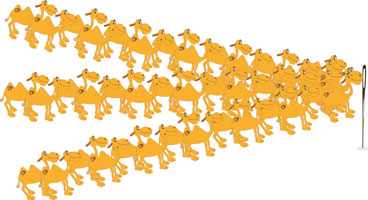
So the question arises: How do you send large volumes of data along a narrow transmission path? In other words: How can you pass a camel through the eye of a needle? If the proverbial camel represents a large picture file, in the case of a video stream it might be more accurate to talk about threading an entire caravan.

And as soon as anyone attempts to retrieve the sequences not just from a single camera but from several cameras, in 'multiple split' mode, across a low bandwidth link for viewing on a computer screen (the equivalent of several caravans passing through the eye of the needle at the same time), the limits of simple streaming processes are reached very soon.
One possible solution to this problem is the method known as dual streaming: In dual streaming, the encoder generates two streams, one of which is used for recording, and the other for transmitting live images. So the recorder can create a high-quality recording using one stream, and at the same time a slightly lower quality stream, which is more economical in terms of bandwidth, can be selected for live picture transmission. But even limits of the capabilities of this method can also be reached very soon. This might happen if a very narrow bandwidth is available, such as when UMTS or edge connections are used, if a multiple split is to be shown, or if both live and recorded image material is to be transmitted at the same time – this last is what happens most often in practice.
The solution can be found in a special transmission process called PRemote-HD, which can even be used to visualise HD and megapixel streams with little available bandwidth. Like dual streaming, PRemote-HD also uses two streams for recording and transmitting. But with the aid of a special transcoding method PRemote-HD achieves remarkable results even with the narrowest of bandwidths, such as are used for mobile communication devices – so transmitting to a tablet or smartphone now works perfectly.
Furthermore, compared with dual streaming, for which only the quality of live images can be modified for transfer, PRemote-HD also allows a bandwidth-friendly transfer of recorded image material. With this technology, live images can be viewed, and the recordings can also be evaluated across great distances with top resolution.
And PRemote-HD can also be used for split streaming. This is when a multiple split is transmitted in a single image, so only one stream is needed – and the bandwidth required is also reduced correspondingly.
And PRemote-HD works with all network cameras that are recorded in MJPEG or H.264 format via RTSP processes.
Reducing the load on the company network and data security
The great advantage of modern IP video technology is that the network infrastructure already installed in the company can be used for the video equipment. However, it should be noted that a video system which continuously carries large volumes of picture data naturally causes a much higher load on the network than is created by normal e-mail traffic, for example. So is there a way to use the existing infrastructure and not overload the company network with the video installation at the same time?
The solution lies with ViProxy. This licence activates the second Ethernet interface at Dallmeier recording systems and thereby provides a video proxy function at the recorder. Thus, it is possible to set up a dedicated network for the video system – which relieves the intranet and further increases security.
With ViProxy the recording system serves as a proxy server for the video system, which means it acts as a connecting link and communication interface between the intranet and the video network. Direct access to the cameras in the video network is thus prevented, as all requests for live image and playback run via the recorder (= video proxy) on which the relevant access rights can be set.
In technical terms, it works like this: The first Ethernet interface at the recorder is the standard interface and is always active. It allows a standard gateway to be used for connecting the device to other networks, e.g., the Internet.
The second Ethernet interface, which is activated with ViProxy, is suited for connecting the recording system to a second local network. For example, it is possible to set up a completely separate network dedicated to IP cameras. The video network is now physically detached from the first network. The major advantage of this is that the network load of the normal intranet remains unaffected by the video network.
Moreover, the video network is not connected with any other network such as the Internet. In this regard ViProxy functions as a firewall that does not allow external access to the video network. The video surveillance system thus fulfils highest security and data protection guidelines.
For more information contact Dallmeier Southern Africa Office, +49 941 8700 209, [email protected], www.dallmeier.com






© Technews Publishing (Pty) Ltd. | All Rights Reserved.
 printer friendly version