



Data storage is one of the most critical components of any internet protocol (IP) security system. You need a storage solution with maximum uptime that can handle the demands of a high-performance video security system to ensure complete coverage for your facility.
Although solid-state drives (SSDs) have been around for decades, they’re only now beginning to replace hard disk drives (HDDs) in security data storage. As technology evolves, SSDs are poised to become the standard for video surveillance storage moving forward.
What is an SSD?
An SSD is a next-generation storage device used for many computer-based applications, including video surveillance systems. Older HDDs use mechanical motors and other moving parts to store data, but SDDs are completely digital. They use simple NOT AND (NAND) flash memory chips to transfer and store data to your device. While HDDs are still in use today, SSDs are steadily replacing them. Many computer companies allow customers to upgrade their existing devices with SSDs.
Although SSDs can resemble HDDs on the outside, they work in entirely different ways. An HDD uses a moving read/write head and a spinning platter to write data to the drive. When you pull footage to review, it uses the same components to access that data.
SSDs use semiconductor chips to store data. When data enters the drive, the SSD saves it to a pool of NAND flash, which stays put even when disconnected from a power supply. This difference makes NAND a type of non-volatile memory – you do not need to refresh it frequently to back it up.
NAND flash is also why SSDs are so much faster than HDDs. Since they do not rely on moving parts to function, they can deliver much higher performance.
The benefits of SSDs and HDDs in security appliances
Although SSDs are becoming more common in today’s security systems, both SSDs and HDDs offer benefits for security applications. Here are some of the advantages of using SSDs for security appliances:
• Durability: If you drop a device that contains an HDD, you’re likely to break one of its delicate internal mechanisms and lose critical data. SSDs are more rugged than HDDs, making them ideal for use in a broader range of environments.
• Reliability: In a recent study comparing HDD and SSD failure rates (www.securitysa.com/*bcd1) over time, researchers observed that standard HDDs failed more often than SSDs. In fact, while the SSDs managed to survive the whole first year without a single failure, the HDDs had a failure rate of 0.66%.
• Small and lightweight: Conventional disk drives are much bulkier and heavier than SSDs, making them less suitable for today’s increasingly compact devices. SSD-equipped devices usually take up less space and their lighter weight makes them easily portable.
• Minimal power consumption: SSDs consume significantly less power than more traditional hard drives, resulting in a lower internal temperature and longer battery life. Since they pull less energy, the device housing the drive can be smaller and quieter than analogue video recording devices.
HDDs are also effective for use in select security devices. Some of the advantages of HDDs include the following:
• Long lifespans: The main advantage of using HDDs is that they typically last longer than SSDs. Although traditional disk drives experience mechanical wear, they take longer to physically break down due to their design.
• High write workloads: Surveillance HDDs are built to withstand demanding workloads and 24/7 functionality, making them highly reliable in operation.
• Higher capacity: Most HDDs have a higher base capacity than SSDs, making them suitable for devices that need to store large quantities of data, such as video recording appliances.
Video surveillance use cases for SSDs
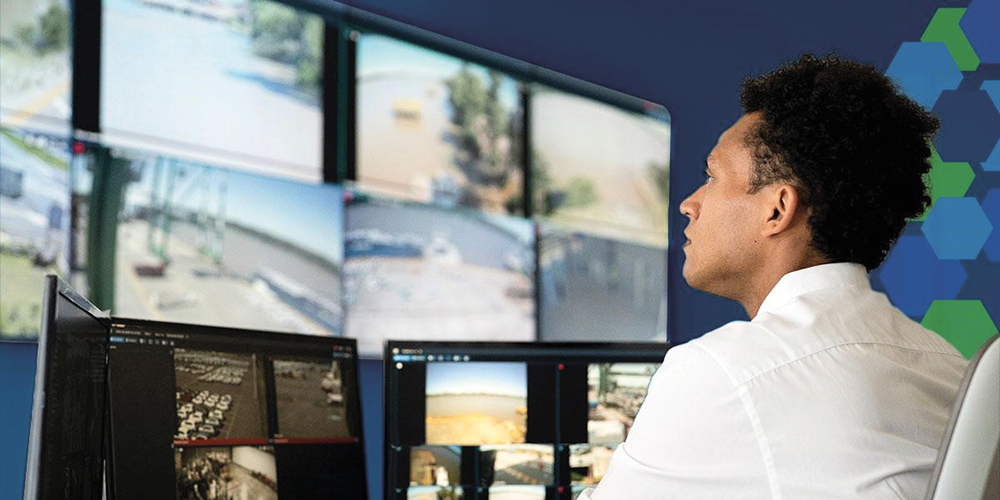
Since it can provide more uptime, higher definition and lower latency, SSD is advantageous in video analytics applications such as:
• Vehicle surveillance: Vibration and shock-resistant cameras on transport vehicles enable you to monitor activity without risking your camera’s safety.
• Incident detection: Highly reliable SSDs can record footage for long stretches of time before failing. This longevity makes them suitable for monitoring critical areas like hallways and building entrances. SSD-equipped NVRs also allow you to access footage quickly, thus speeding up incident investigation and reducing frustrations.
• Thermal imaging: Monitoring chemical leaks, such as gas leaks, is critical for public spaces. Wide-temp SSDs can handle extreme temperatures, making them suitable for use in environments where the temperature could suddenly change due to a leak.
BCD products that use SSDs
BCD provides every piece of the surveillance system, from servers and workstations to network switches and storage. Some examples of our SSD-equipped products include our video recorders, surveillance workstations and harsh environment servers.
Video recording appliances: Video recording devices process and store footage from IP cameras. These devices come in two types – digital video recorders (DVRs) and network video recorders (NVRs). DVRs store footage on digital storage devices, while NVRs use network connections to record video.
The small size of SSDs enables compact, all-in-one NVRs suitable for environments from small banks to enormous warehouses. Their simple configuration allows for easy installation and setup, enabling businesses to simplify their tech systems.
BCD video recording appliances can support from four to 4000 cameras simultaneously, enabling you to maximise your bandwidth. Additionally, with built-in redundancy and 24/7 duty cycle drives, you can count on our recording devices to provide high reliability and uptime.
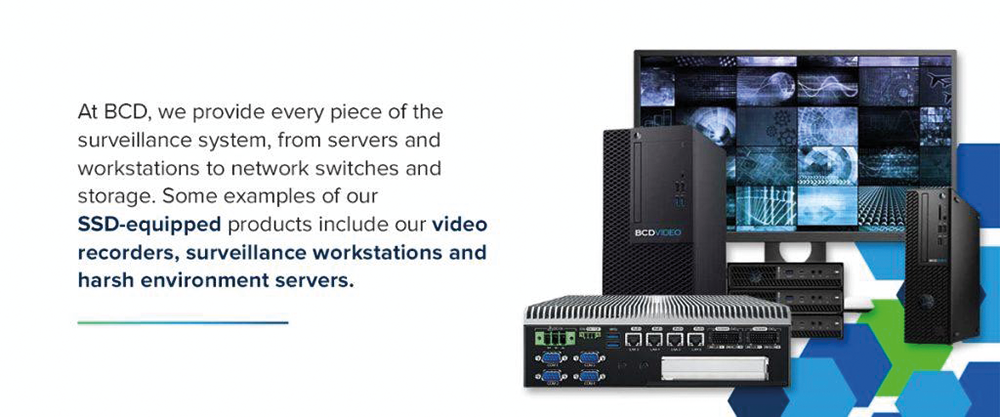
Workstations: Video surveillance workstations are the delivery point for video surveillance feeds. They host all their processes locally, freeing up valuable NVR space and allowing efficient video recording and management.
SSDs’ low latency and high uptime mean you can view real-time feeds from remote workstations with incredibly high definition. If anything happens on camera, your operators are sure to catch it.
BCD workstations are equipped with the latest graphics processing units (GPUs) from NVIDIA and next-generation Intel processors. This exceptional processing power allows them to provide extremely high-quality playback and video analytics capabilities for various projects.
Harsh environment servers: Because SSDs do not contain delicate mechanical parts, they’re suitable for the severe conditions that harsh environment servers face.
A harsh environment server is a remote server that hosts video processing on the edge. They often must withstand rough conditions, such as extreme temperatures and mechanical stresses, for long spans of time without compromising performance.
We designed BCD Video’s purpose-built harsh environment servers for just those environments. With Power over Ethernet (PoE) ports, terabytes of storage and wide-temperature SSDs, BCD’s harsh environment servers are industry leaders in performance and reliability.
Article sourced from www.bcdvideo.com/blog/ssds-in-video-security-systems/. For more information go to www.bcdvideo.com, or www.firstdistribution.com/bcd/






© Technews Publishing (Pty) Ltd. | All Rights Reserved.
 printer friendly version